
 AI Overviews
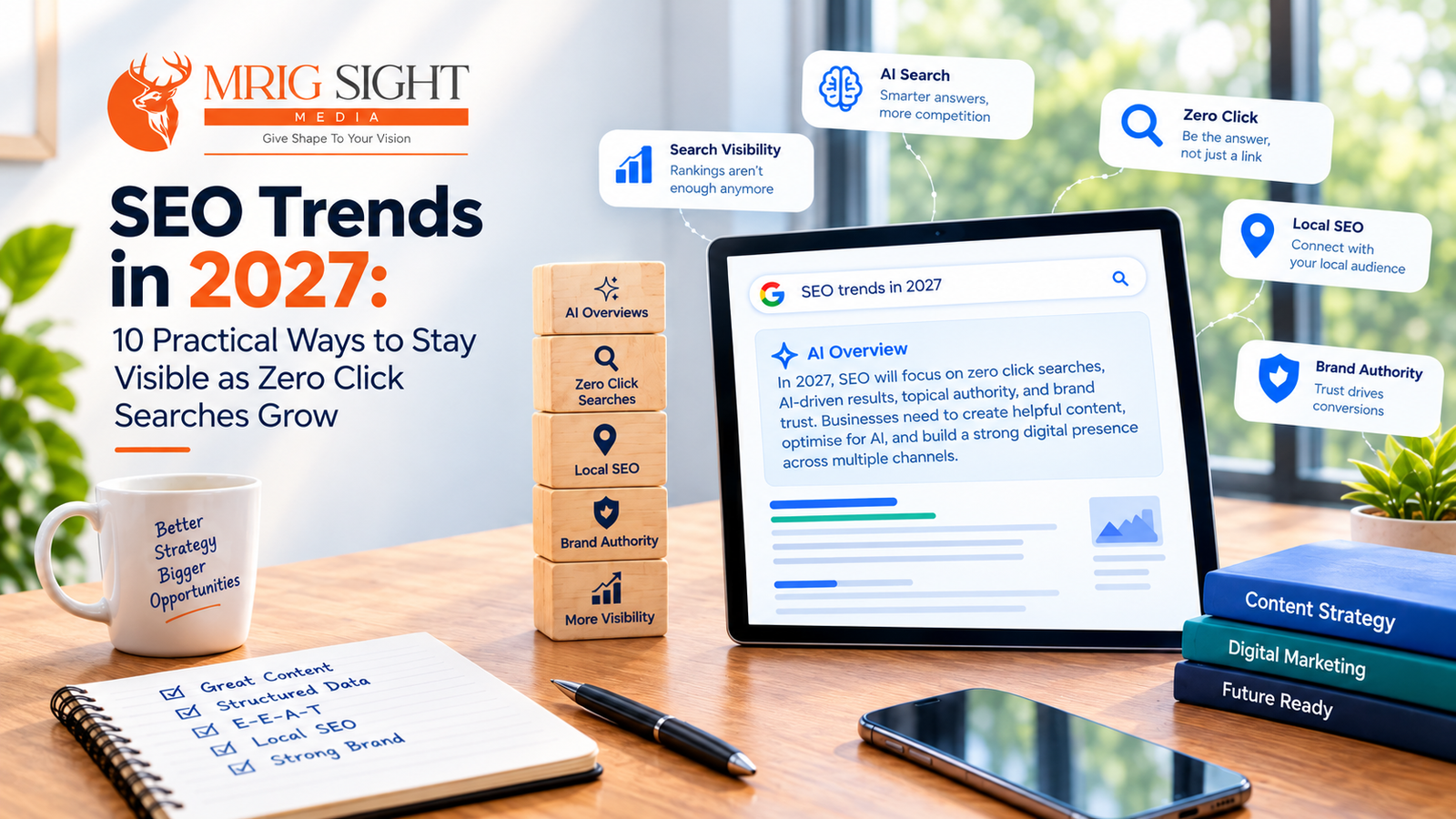
By Mrig Sight Media | Public Relations & Digital Marketing Agency, Noida, India | Published and last updated:
Quick Answer
Zero click searches are searches where people get what they need on the results page, through AI Overviews, featured snippets, local results or knowledge panels, without visiting a website. To stay visible in SEO in 2027, write answer-first content, match search intent, build topical authority, show real experience, strengthen local and brand signals, and measure leads and conversions instead of clicks alone.
Introduction
SEO is changing, but not in the way many businesses expect.
For years, the goal was straightforward: identify the right keywords, optimise a website, improve rankings and bring more visitors to the site. Those activities still matter. However, the way people discover information has become more complicated.
Someone searching for a marketing agency might compare businesses through Google results, read reviews, explore social media and use AI tools before visiting a website. Another person searching for a simple definition might find the answer on the results page and never click a link. This is where zero click searches become important.
The most important SEO trends in 2027 involve more than keywords and backlinks. Businesses need to pay attention to content quality, search intent, website performance, brand authority and the experience people have after discovering them.
At Mrig Sight Media, we treat digital visibility as a mix of search optimisation, content, branding and user experience. A website can attract visitors without generating enquiries, just as a brand can build recognition through search visibility even when not every interaction ends in a click. Below are ten practical strategies for 2027 and a realistic action plan.
What Are Zero Click Searches, and Why Do They Matter?
A zero click search happens when someone finds the information they need on a search results page without visiting an external website. This can happen through featured snippets, knowledge panels, local search results, calculators, instant answers and AI generated summaries.
Someone searching for the meaning of SEO may get a useful explanation immediately. Someone searching for an SEO agency in Noida may want to compare services, check credibility and speak to a provider before deciding. The two searches have different purposes, so the impact of zero click behaviour is not the same.
A reduction in clicks does not automatically mean SEO has stopped working. It may mean businesses need to understand visibility, user intent and conversions more carefully. The practical question is not "How do we get more clicks?" but "How do we become the brand people notice, trust and choose?"
10 Practical Ways to Stay Visible as Zero Click Searches Grow
1. Write Answer-First Content
Long introductions before the point no longer work. Search engines, AI tools and readers all prefer clear, direct answers.
- Put a 40-60 word answer right under the heading.
- Use the question as the heading, then answer it immediately.
- Add detail, examples and proof after the answer.
This can improve your chances of earning featured snippets and being cited in AI generated answers, although no format guarantees inclusion. It also helps real readers get what they need faster.
2. Build Topical Authority, Not Just Keyword Pages
A common mistake is a website with dozens of posts on unrelated topics. Sites that cover a subject in depth give search engines and readers a clearer reason to trust them.
- Choose 3-5 core topics your business truly knows.
- Create one pillar guide for each topic.
- Support each pillar with smaller articles that answer related questions.
- Connect them with descriptive internal links, for example from this guide to our SEO services in Noida.
3. Show Real Experience (E-E-A-T)
AI can produce average content in seconds. It cannot produce lived experience, which is your biggest advantage. E-E-A-T is a framework from Google's quality guidance, not a ranking score.
- Share what you tested, what failed and what you learned.
- Add author names and relevant credentials.
- Use original screenshots, data and case notes, with permission.
- Describe real situations instead of vague theory.
If anyone could have written your article, it will be treated like content from anyone. Never invent results or claim a tactic caused growth without evidence.
4. Use Structured Data (Schema Markup) Correctly
Schema helps search engines understand your content without guessing. Missing or broken markup is one of the most common and easiest technical issues to fix.
- BlogPosting: headline, author, dates and image.
- BreadcrumbList: the page's position in your site.
- Organization and LocalBusiness: verified business details.
- FAQPage: only where it matches visible questions and answers.
Schema must match what users can see. It does not guarantee rich results, higher rankings or AI Overview citations. Test your markup with Google's Rich Results Test before publishing.
5. Optimise for Entities and Your Brand
Search engines increasingly think in entities (people, brands, places and things) as well as keywords. If your brand is unclear online, search and AI systems have less to work with.
- Keep your business name, address and description consistent everywhere.
- Build a clear About page.
- Link your official social profiles.
- Earn mentions on trusted industry sites and directories.
A recognisable brand is one of the most durable assets in a zero click world, because people who remember you search for you by name.
6. Create Content AI Cannot Easily Replace
If a chatbot answer fully replaces your article, the article is not adding enough value. Give people a reason to click beyond the basic answer.
- Original research and small surveys.
- Step-by-step case studies with real numbers.
- Free templates, checklists and calculators.
- Honest comparisons and expert opinions.
7. Make Content Easy to Scan and Quote
Clear structure helps both readers and AI systems understand your page.
- Use one H1 and a logical H2/H3 structure.
- Keep paragraphs to two or three lines.
- Use bullets, tables and numbered steps.
- Add a short summary or key takeaways section.
- Define important terms in one clear sentence.
8. Focus on Search Experience Optimisation (SXO)
Ranking is only half the job. If visitors leave in five seconds, the click was wasted.
- Match the page to search intent. Do not use a sales page for an informational query.
- Improve page speed and Core Web Vitals.
- Keep the design mobile-friendly and easy to read.
- Add clear next steps, such as a free audit or contact form.
- Remove intrusive pop-ups.
9. Strengthen Local and Multi-Platform Visibility
People search on YouTube, Instagram, Reddit and inside AI assistants, not only Google. For businesses serving specific areas, local results often show reviews, hours and contact details before anyone visits a website, so local SEO deserves real attention.
- Keep your Google Business Profile complete and accurate.
- Collect genuine reviews and reply professionally.
- Create useful location pages for areas you genuinely serve, such as Noida and Delhi NCR.
- Turn key articles into short videos and social posts.
- Avoid near-identical city pages that change only the place name.
10. Track the Right Metrics
If you only track clicks, zero click search will make your reports look worse than reality. Measure more than traffic:
| Metric | Why it matters |
|---|---|
| Impressions and visibility | Shows how often your pages appear in search results |
| Clicks and click through rate | Shows which titles and snippets earn visits |
| Branded search growth | Shows whether people look for you by name |
| Qualified leads, calls and form fills | Connects SEO to business outcomes |
| AI referral traffic | Tracks identifiable visits from AI platforms, where analytics can attribute them |
AI visibility is hard to measure fully. Referral data misses some exposure, so avoid treating any single tool as a complete picture. Fewer clicks with better leads is often a win.
A Practical 90 Day SEO Plan for 2027
Businesses do not need to implement everything at once. A phased plan makes it easier to prioritise and to see whether changes are helping.
Days 1 to 30: Understand the Current Position
Start with a website audit covering indexability, canonical URLs, key landing pages, internal links, mobile usability and performance. Use Google Search Console to find pages with strong impressions or declining clicks. Record baseline traffic, enquiries and conversions, and choose a small group of important pages instead of fixing the whole site at once.
Days 31 to 60: Improve Priority Pages
Refresh service pages and articles according to search intent. Improve headings, remove repetitive text, add useful examples, strengthen internal links and make calls to action clearer. If several pages overlap heavily, differentiate or consolidate them.
Days 61 to 90: Build Authority and Review Results
Publish supporting content where there is a clear information gap, pursue relevant digital PR and improve local business information. Then compare impressions, clicks, queries, qualified enquiries and conversions against your baseline. Ninety days is a review period, not a guarantee of rankings or traffic growth.
Common SEO Mistakes to Avoid in 2027
- Keyword stuffing: Use relevant terms where they add clarity.
- Generic AI content: Add original analysis and verify facts.
- Ignoring technical problems: Check that important pages can be crawled and indexed.
- Low quality link building: Prioritise relevant editorial relationships over volume.
- Chasing AI search shortcuts: No special formatting guarantees inclusion in AI answers.
- Measuring only rankings: Rankings do not automatically translate into enquiries or revenue.
- Publishing without a clear purpose: Every article should meet a real information need.
The common thread is simple: base decisions on your audience's needs and evidence from your website, not on the latest SEO trend.
How Mrig Sight Media Can Help Businesses Improve Search Visibility
Mrig Sight Media is a branding and marketing agency in Noida that helps businesses strengthen their digital presence and reach relevant audiences. Technical SEO helps search engines access important pages, content strategy answers customer questions, branding and PR support recognition, and a good website experience turns discovery into action.
Our digital marketing services in Noida cover the full customer journey, and our Answer Engine Optimisation (AEO) services focus on visibility in AI powered search experiences. The right strategy depends on your website, audience, competition and goals.
No agency can guarantee a particular ranking or placement in an AI generated answer. A clear, evidence based approach to SEO, AEO and digital marketing can still help you make informed decisions and build a stronger foundation for long term growth.
Conclusion: Focus on Visibility, Trust and Business Results
The biggest lesson from the SEO trends in 2027 is to stop treating search optimisation as a collection of isolated tasks. Keywords need useful content behind them, technical SEO must support a good user experience, and backlinks help most when they sit alongside a credible brand.
Start with an honest website audit, fix the biggest barriers, publish content that adds genuine value and review performance regularly. Get in touch with our team to discuss a practical SEO plan for your business.
Frequently Asked Questions About SEO Trends in 2027
What are the biggest SEO trends in 2027?
Important areas include AI powered search, search intent, helpful content, topical authority, technical SEO, local search, digital PR, brand visibility and website user experience. Businesses should prioritise the changes most relevant to their audience and current performance.
What does zero click SEO mean?
Zero click SEO is an informal term for improving visibility and brand discovery in search experiences where users may find answers without visiting a website. It involves creating useful content, building brand recognition and evaluating visibility alongside clicks and conversions.
Will zero click searches reduce organic website traffic?
They can reduce clicks for certain queries, especially when the search results page directly answers a simple question. The effect varies by query and industry. People researching complex problems or comparing services may still need to visit websites.
How can I improve my website's visibility in Google AI Overviews?
Follow established SEO practices. Create useful, original content, keep important information accessible as text, ensure important pages are indexable and provide a good user experience. These practices support eligibility, but inclusion in AI Overviews is not guaranteed.
Is traditional SEO still relevant in 2027?
Yes. Search intent, crawlability, relevant content, internal linking, technical accessibility and user experience remain important. Businesses should adapt their SEO strategy to changing search behaviour rather than abandon its fundamentals.
Does structured data guarantee higher rankings?
No. Structured data helps search engines interpret specific information about a page and may support eligibility for certain enhanced search appearances. Correct implementation does not guarantee higher rankings or special search features.
How should businesses measure zero click SEO performance?
Track organic impressions, clicks, click through rates, branded search trends, qualified leads and conversions. Review identifiable AI referral traffic where available. Use these metrics together because no single measure captures every instance of search visibility.
Is local SEO still important for Indian businesses?
Yes. Local SEO can help eligible businesses appear for relevant geographic searches. Accurate business details, useful location pages, genuine reviews and a consistent online presence can support local discovery.
How long does SEO take to show results?
There is no fixed timeline. Results depend on competition, website condition, content quality, technical implementation and search demand. Some improvements may be visible relatively quickly, while broader changes can take several months or longer.
What should businesses do first to prepare for SEO in 2027?
Begin with a website audit. Review indexability, important landing pages, search intent, mobile usability, performance and conversion tracking. Use the findings to prioritise improvements before investing heavily in new content.
Should businesses create separate content for every AI search question?
Not necessarily. Create separate pages when they serve distinct user needs. When several questions belong naturally within one comprehensive article, answer them in relevant sections instead of producing repetitive pages.
Can a small business compete with larger brands in organic search?
Yes, depending on the market and query. Small businesses can focus on specific customer problems, genuine expertise, useful local information and well targeted service pages. Success is not guaranteed, but a focused strategy can help.